


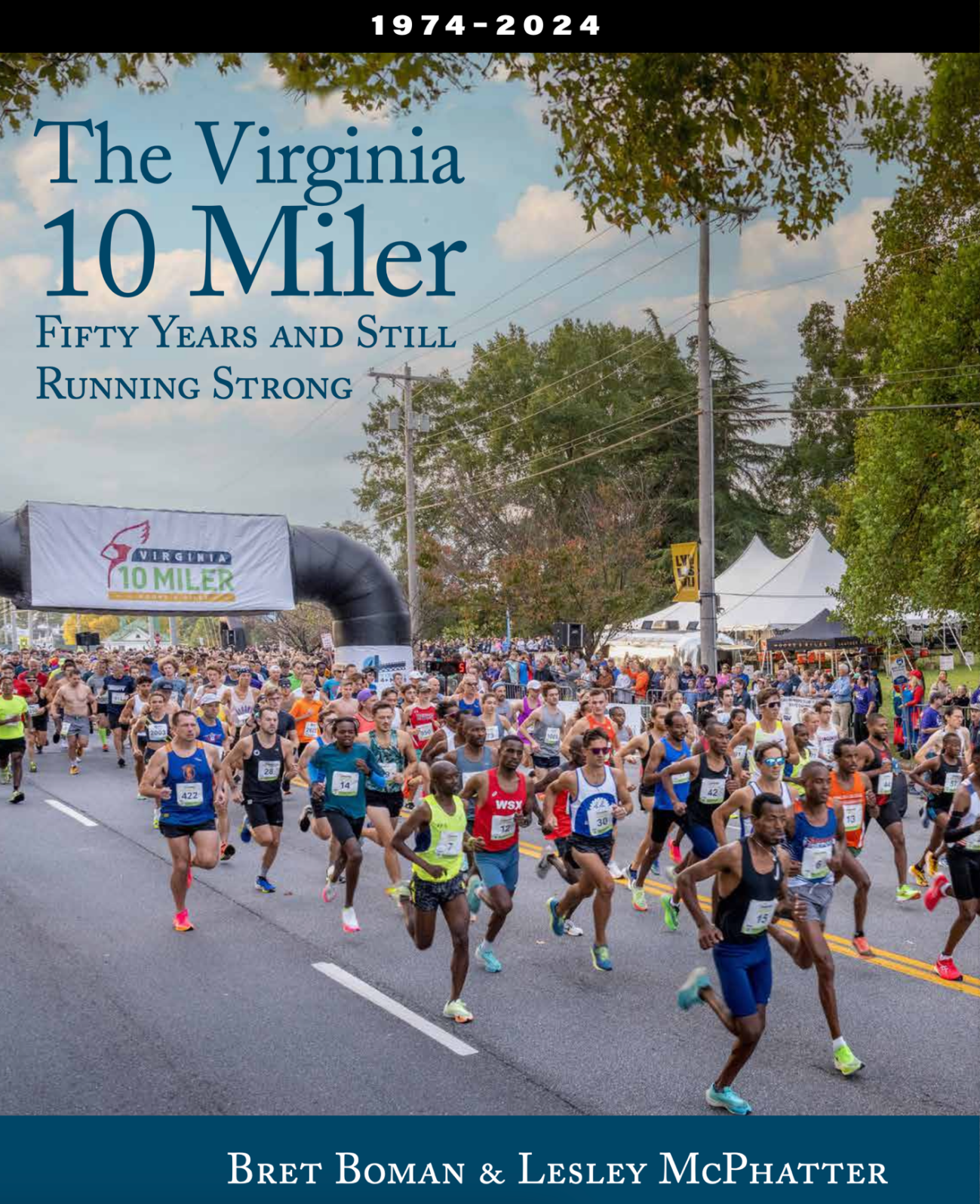
On Friday, Sept. 6, the Lynchburg Museum hosted co-authors Bret Boman and Lesley McPhatter for a signing of their new book, “The Virginia 10 Miler: Fifty Years and Still Running Strong.” The book tells the story of how this 10-mile race put Lynchburg on the map that attracted distance runners from across the world, including Olympic gold medalists and national champions. The race rode the tide of the running boom in the 1970s and ’80s and quickly grew in size and stature.
Beyond the races, this is the story of the runners, the volunteers, the spectators — as well as the Kiwi athletes, a rabbit on a motorcycle and winged foot trophies.
How the race all started
At 10 a.m. on Sept. 21, 1974, in Lynchburg, the starting gun fired for the first Virginia 10 Miler road race, echoing the running boom that started when Frank Shorter won the gold medal in the marathon two years earlier in Munich. One hundred and seventy-four men and seven women finished that inaugural race, conquering the hills of Lynchburg.
George Stewart, CEO of race sponsor First Colony Life, was pleased with the results but challenged race director Rudy Straub to bring in the best runners in the world. Straub embraced this directive: “What I have to do each year is look ahead to what I think is going to be the most exciting from a spectator standpoint. And it turned out that Bill Rodgers and Frank Shorter, of course, in those days, that was the duel.”
When the starting gun fired a second time, Frank Shorter and 1974 Boston Marathon champion Bill Rodgers took off and battled for 9 miles, at which time Rodgers persuaded Shorter to finish together. Ironically, Rodgers was declared the winner and Shorter was awarded second place, although they were given identical times.
This race, the “tie,” put Lynchburg and the Virginia 10 Miler on the map of great U.S. road races and kicked off the rivalry of two of America’s greatest distance runners. Over the course of its 50-year history, the race rose to its zenith, declined for a period and then climbed back to become one of the top 10-mile races again.
During the race’s half century, world-class athletes from 13 countries have learned about, and sometimes been humbled by, the treacherous 1.5-mile “Farm Basket” hill. Women have become equal in participation, growing from the original seven runners to over 50% when counting all the 10 Miler events. This growth paralleled a worldwide change where, in the biggest international contest, the longest women’s running event increased from just under a mile to a full marathon (26.2 miles).
The running experience also changed. Previously upon finishing the race, runners were herded into chutes until their place and time were manually recorded. Today, chips in the race numbers allow a runner’s result to be texted to family and friends, seconds after finishing.
What hasn’t changed is how Lynchburg welcomes runners, which validates the motto “Where Southern hospitality meets the road.”
For more information and to buy “The Virginia 10 Miler: Fifty Years and Still Running Strong” book, please visit virginia10miler.com. The book is also for sale at the Lynchburg Museum.


