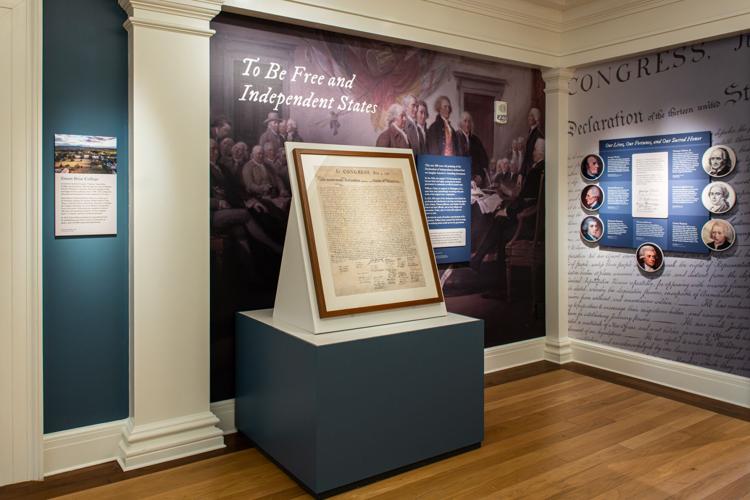


Anyone who has stood before the original Declaration of Independence at the National Archives Museum in Washington, D.C., understands the significance of seeing the document that announced America's break from Great Britain and articulated the ideals on which the nation was founded. Protected within a specially built encasement designed to preserve it for generations, the faded parchment still bears the enduring words: “We hold these truths to be self-evident, that all men are created equal, that they are endowed by their Creator with certain unalienable Rights, that among these are Life, Liberty and the pursuit of Happiness.”
By 1820, however, the original 1776 Declaration had become faded and fragile to the point that there was concern it would become illegible and lost forever. Secretary of State John Quincy Adams commissioned preeminent engraver William J. Stone to create a duplicate.
People are also reading…
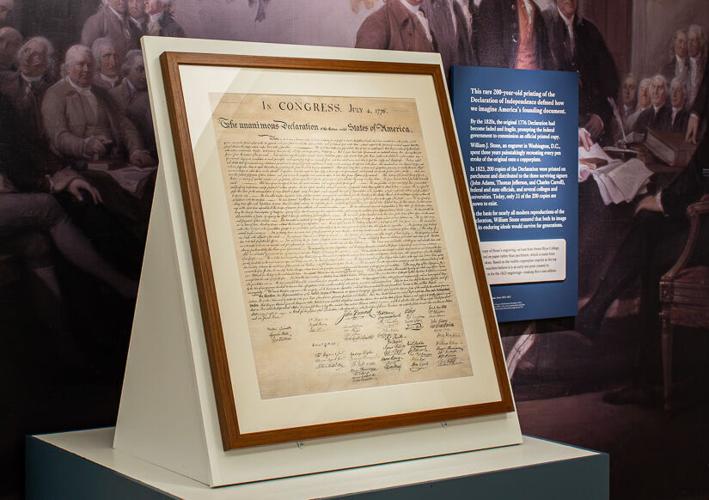
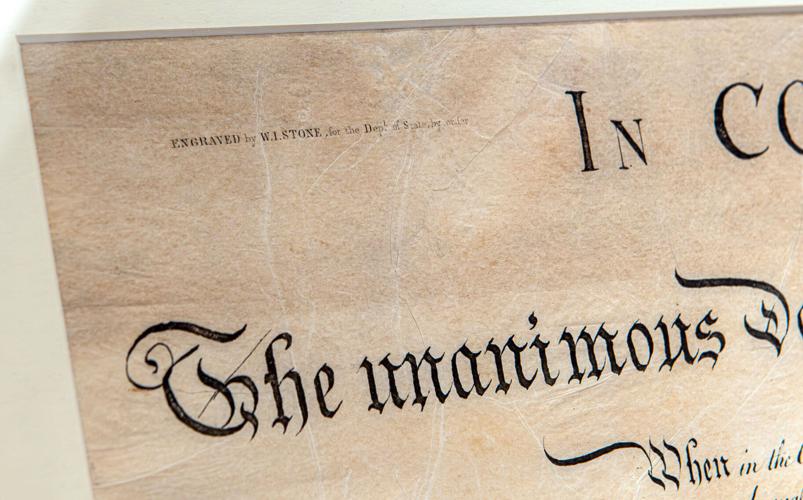
Stone spent three years painstakingly recreating every pen stroke of the original onto a copperplate. The finished engraving served as the master for a limited edition of 201 parchment copies distributed in 1823 to the three surviving signers: John Adams, Thomas Jefferson, and Charles Carroll, as well as the Marquis de Lafayette, federal and state officials, colleges, and universities.
“As the basis for nearly all modern reproductions of the Declaration, William Stone ensured that both its image and its enduring ideals would survive for generations,” says Virginia Museum of History & Culture’s Senior Director of Curatorial Affairs, Andrew Talkov.
Today, only 31 of the official Stone Engravings are known to survive.
Until recently, the version on loan to the VMHC from Sweet Briar College was believed to be one of those copies. However, conservation work completed earlier this year revealed that it was printed on paper rather than parchment and bears a visible copperplate impression in the upper-right corner. Those details suggest it may instead be one of just six known test prints produced before the final 1823 edition, making it even rarer.
The document on display at the museum is one of only two known test prints still in existence.

“The final month leading up to the passing of the Declaration of Independence was a consequential time for the aspiring nation,” says VMHC President & CEO, Jamie Bosket. “Virginians were at the center of this fervor. Richard Henry Lee, on behalf of the Virginia Delegation to the Second Continental Congress, stood among his peers, proposed American Independence, and changed the world. His motion, which was ultimately approved on July 2, 1776, set in motion the drafting of the Declaration. We are exceedingly proud to display this rare historical treasure as we mark these important American milestones.”
Originally scheduled to remain on view through July 4, the exhibition has been extended through Sunday, Aug. 2, due to popular demand. The new closing date carries its own historical significance: Aug. 2 marks the 250th anniversary of the day the Declaration of Independence was formally signed in 1776.