


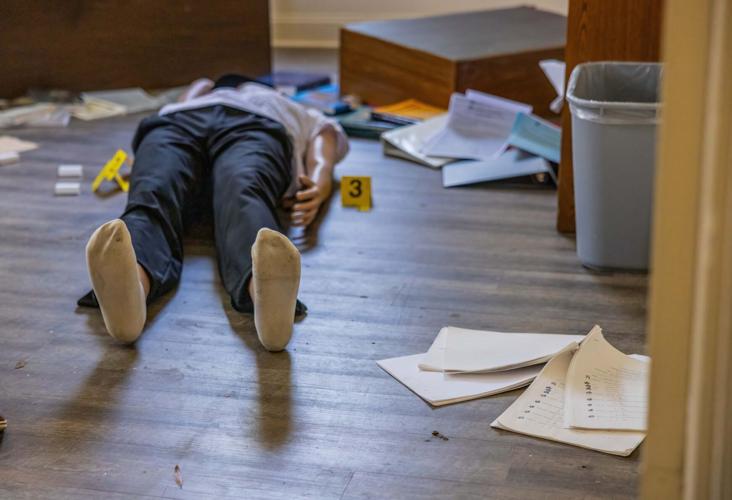
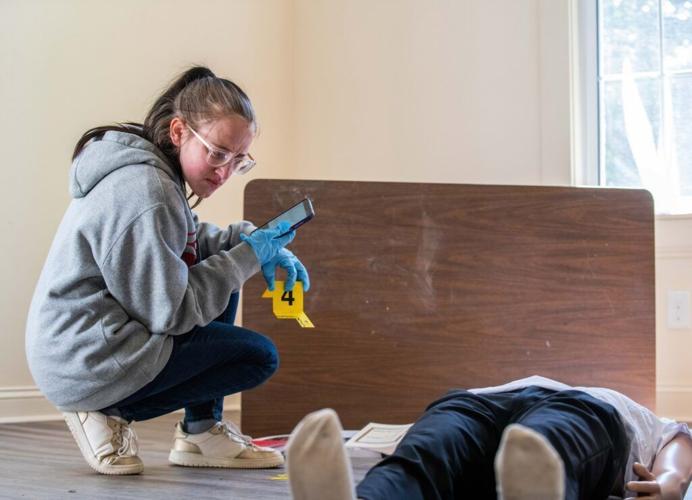
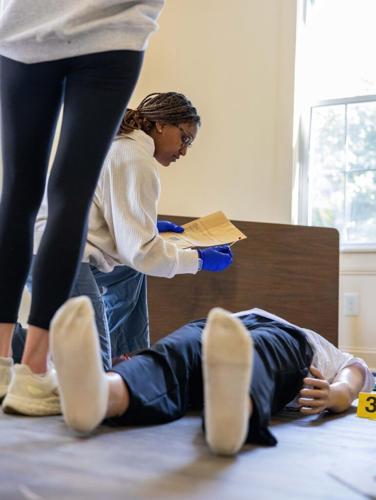
It’s a Wednesday afternoon in early April, and foul play is afoot at Criminology House. In a room at the back of the small white house, located at 500 Westwood Street, furniture has been upended and a mannequin lies on the floor, a red stain on the chest of its white T-shirt.
The police dispatcher, in this case a student enrolled in Professor Dan Murphy’s Crime Scene Investigation class, has been notified of a man screaming, and a police officer — yet another student — has responded to the scene.
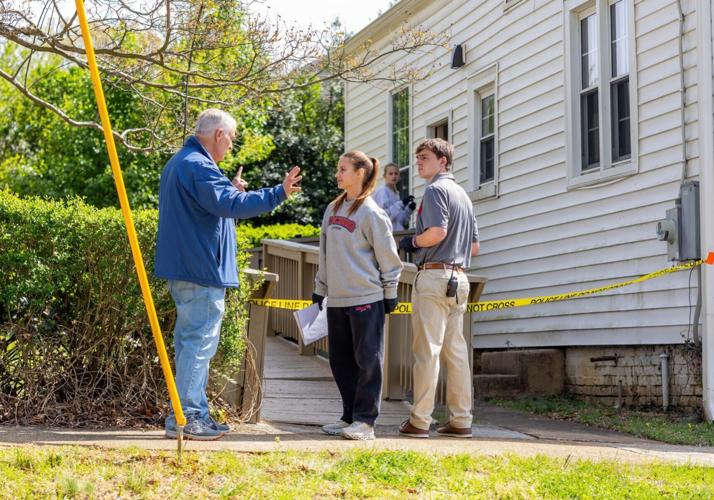
Yellow-and-black crime scene tape is strung outside and inside the house. The medical examiner and forensic investigators, also played by members of the campus community, have been summoned. It’s Crime Scene Day at the University of Lynchburg.
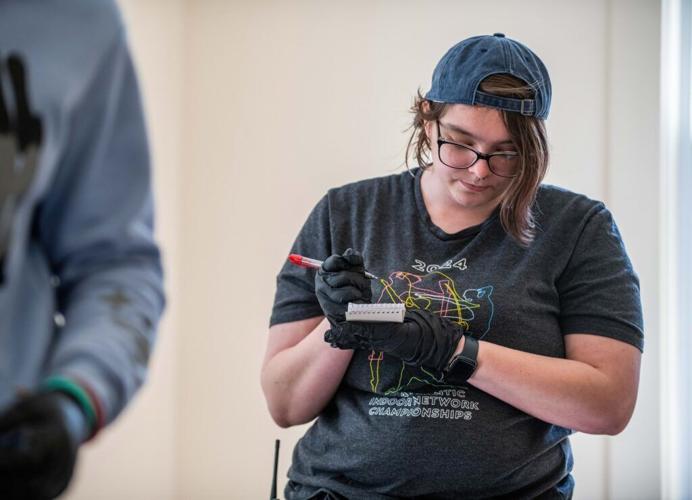
Murphy’s annual Crime Scene Day is the culmination of a semester’s worth of lessons and hands-on workshops attended by Crime Scene Investigation students. The class, Murphy’s most popular, is a requirement for Lynchburg’s new criminal forensics major — believed to be the first of its kind offered by a college or university.
People are also reading…
During the semester, there were classroom visits by police dogs and canine officers, workshops in fingerprinting and footprint casting presented by local law enforcement, and lectures by Murphy, a career law enforcement officer who started teaching at Lynchburg in 2010.
One question remained, however: On Crime Scene Day, how would the students apply what they’d learned?
“I told them you never know what you’re going to encounter at a crime scene,” Murphy said. “You don’t know who’s going to be there. You don’t know what they’re going to do. You have to improvise. You can talk about it all day long, but to actually have to do it you learn something.”
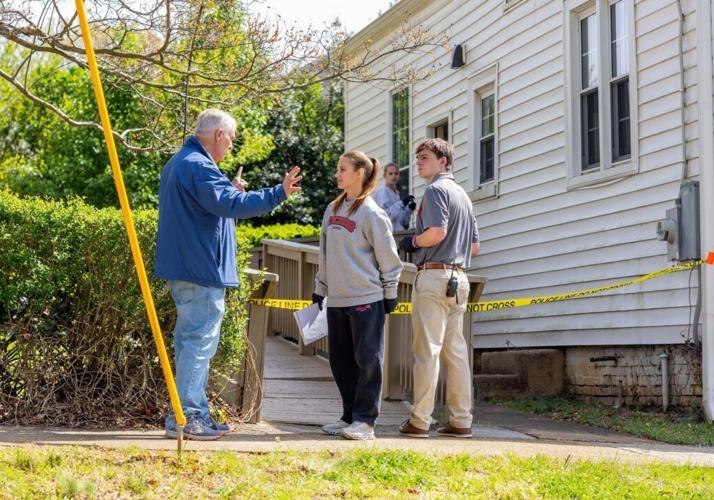
Standing outside the “crime scene” at the start of one of four scenarios that would be conducted on Crime Scene Day, Murphy gives a play-by-play.
“This is the supervisor,” he says, pointing to a student who is approaching the back door of Criminology House. “The officer’s advising the supervisor what’s going on. They should be going in with their hands in their pockets, so they don’t touch anything.”
Then, two more “officers” approach the house.
“This is the CSI team, which consists of two people, one processing the evidence and the other photographing the evidence,” Murphy says. “The sergeant has been there, the officer responding to the scene, and now let’s see what they do.”
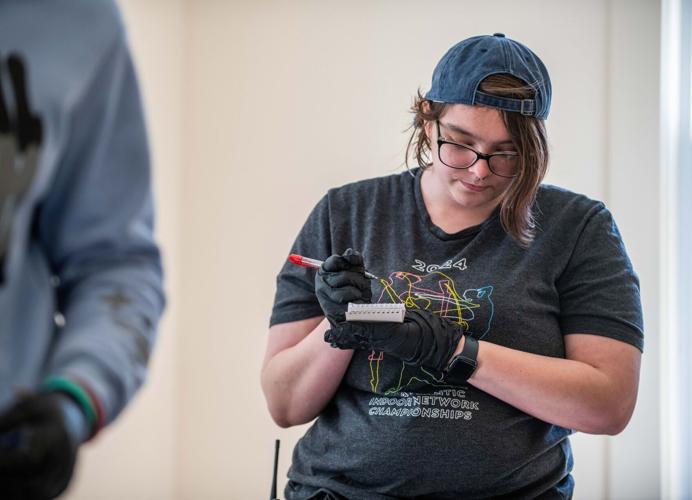
While the CSI students secure the crime scene, gather evidence, and snag potential witnesses and suspects — everything law enforcement officers would do in this situation — Murphy does what he can to coach and support the students. He also throws a few wrenches.
He points out a young woman, dressed all in beige and holding a cell phone. She’s standing behind Lynchburg’s History House, on Brevard Street. History House shares a backyard with Crim House, also known as the crime scene.
The woman, a Lynchburg student, is part of the scenario, placed there by Murphy as a potential witness. The CSI students don’t have long to notice her.
“We’re going to see if one of them approaches that witness over there,” Murphy says, “because they’ve got a couple minutes. If they don’t approach that witness over there, I’m going to wave to her and just say, ‘Goodbye,’ and they just lost testimonial evidence.”
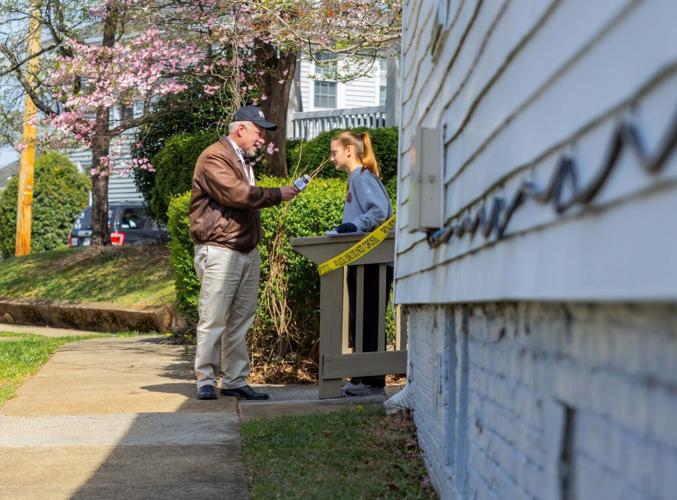
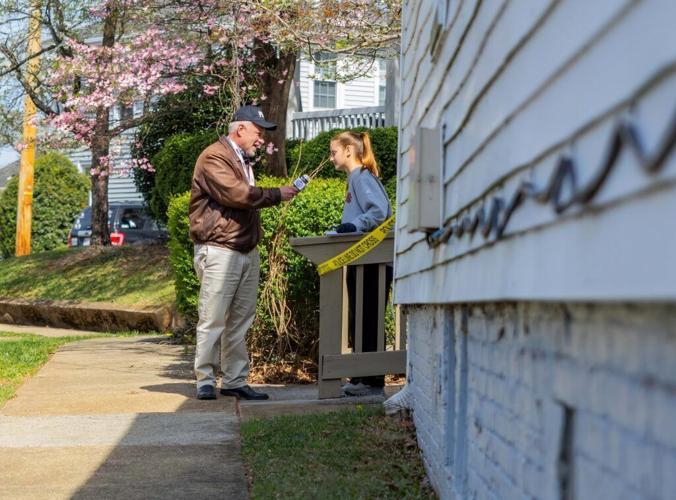
At the same time, Dr. Tim Schauer, interim dean of the School of Professional and Applied Sciences, is skulking behind the hedge between College Street and Knight-Capron Library. He’s wearing press credentials around his neck and a black ballcap emblazoned with “PRESS” on his head. In his hand, he holds a prop microphone.
On Crime Scene Day, it’s Schauer’s job to be what he describes as “the nosy reporter” who is trying to access the crime scene. It’s the CSI students’ job to deflect him. When Schauer crosses the street and tries to enter the crime scene, he’s turned away by the officer guarding the perimeter.
“I did it in three of the four [scenarios], and they were really good,” Schauer said of the students. “You have a power struggle here, right? You’ve got a professor, a dean, and these are students, so it takes a lot to go, ‘No, no, you’re not welcome. You’re not allowed here.’
“So, I thought each of the teams did a great job. They were professional, they were courteous, they were respectful, but they were firm.”
Meanwhile, the officer who chased off Schauer hasn’t noticed the potential witness.
“If they don’t notice her, they kind of screw up that part of it because they’re supposed to notice her and ask her if she saw anything,” Murphy explains, waving off the young woman. “They’ve blown it. They haven’t identified this person as a possible witness and they’re losing testimonial evidence.”
After performing crime scene technician duties in one scenario, criminology major Ciara Christner ’26 said she hopes to put what she learned on Crime Scene Day into real-world practice soon.
“I plan on doing crime analysis,” she said, “so a little more lab with it, but I also want to learn how to be on a case and on a crime scene and kind of see what I’m supposed to do.”
Christner said she and her team spent “long days” practicing for their scenario.
“It was a lot, but then it was a lot of fun. I feel like we really put all the knowledge we learned to good use, and I feel like it was one of those things where you were a little more nervous going into it than when you got there. …
“It was a good learning experience. It was very fun, but also really educational.”
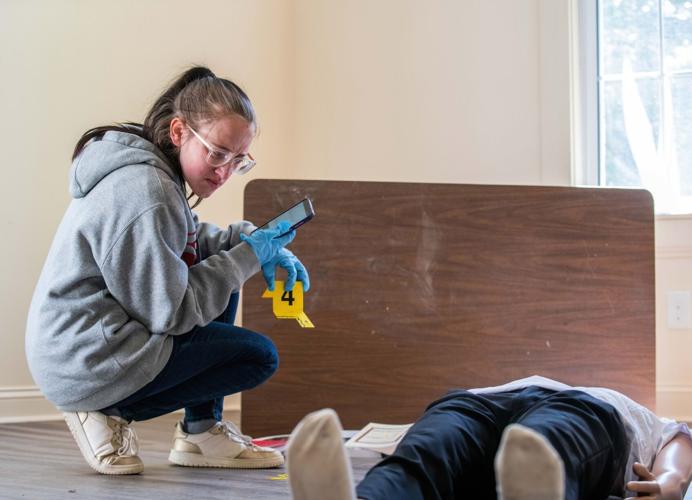
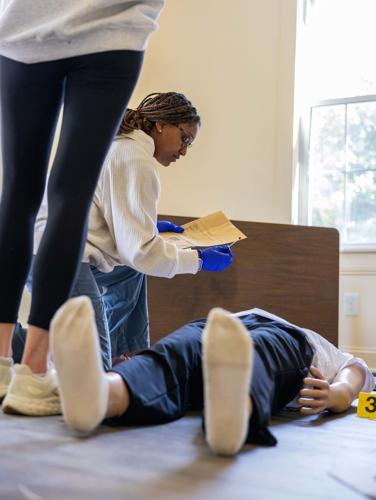
Later, inside the house, Murphy reminds the students about the kinds of evidence they’re supposed to be looking for — ballistic, biological, latent, trace — and coaches a student who’s photographing evidence prior to it being bagged and tagged.
“If you see evidence, place the marker down and then start taking pictures,” Murphy says, also telling the photographer to “use your time efficiently.”
Outside again, it’s time for the suspect, “Rachel,” to arrive on the scene. As she approaches the scene, Rachel — played by criminology major Kaitlyn Bain ’26 — appears frantic. She says, “I heard a scream,” and asks the officer outside the house what happened.
Bain is wearing a white T-shirt and jeans. On the bottom of her shirt, there’s a small red stain — designed to look like blood. It’s up to the officer on the scene to see the stain and question the suspect about it. Some of the four teams did better than others.
“Team two identified the suspect and said, ‘You’re not going anywhere.’ They handled it perfectly,” Murphy said.
While some teams didn’t detain the suspect or missed the blood altogether, Murphy said the goal was to learn from any mistakes. “I said, ‘You let the person go. They had evidence on their shirt. You’re letting that shirt go. That’s evidence.’ … It was a great learning experience. It took a lot of work. I’m exhausted.”
Schauer was impressed by Murphy’s ability to “quarterback all of the activities” of Crime Scene Day. “There’s a lot,” he said, “because there’s a lot of acting, a lot of parts, and it has to be precise. All while he’s trying to engage students and coach them through it. I think that’s pretty cool. He’ll sleep well tonight.”
In the scenarios, Murphy made some evidence harder to find than others, hiding “blood splatter” in leaves outside the house and placing a note in a trash can. When he thought the students might miss important evidence, Murphy said he’d give them a nudge.
“I kept saying, ‘Hmm, it seems like you got a lot of it.’ What’s that subliminal message? I’m saying ‘a lot, but you don’t have all of it,’ so they had to go back and say, ‘What are we missing?’ One group, at the very end, said, ‘What else could we look for? We could look in the trash.’ … They all did a great job. They all made mistakes, but that’s what school is about.”


